Co-Curricular Activities for Student Development
Apr 27, 2026
Discover the importance of co-curricular activities in student development. Improve skills, confidence, and teamwork beyond academics.
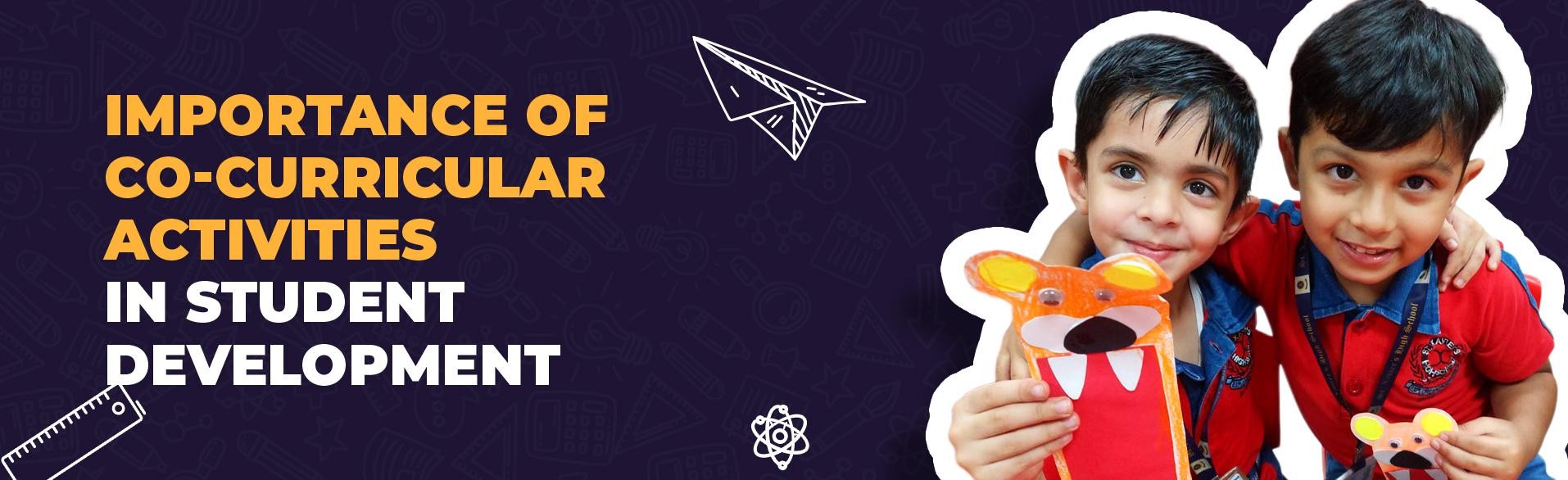
A child can spend an entire morning refusing to answer a single question in class and then suddenly come completely alive the second someone brings out a tambourine.
That sudden shift matters much more than most adults realize. Co curricular activities often get described as the lighter part of a school day. They are seen as the fun period, the noisy period, or the break from real learning. But for young children, that description misses the point entirely. These moments are not pauses in a child's development. They are exactly where development becomes visible to the naked eye.
A four-year-old who hesitates to speak during morning Circle Time may still happily join a rhyme action game without being asked twice. A child who completely struggles to sit still during a tracing activity may focus deeply while stacking wooden blocks or following a movement pattern during a dance class. The learning is absolutely still happening. It is simply taking a form that a young brain can enter much more naturally.
The Real Importance of Co Curricular Activities in the Early Years
The importance of co curricular activities becomes very easy to understand when one stops asking whether a child is being entertained and starts asking what the child is actually practicing.
During a messy, loud art activity, a child is not just aggressively coloring outside the lines. They are learning how to begin something, stay with it, make a choice about a color, and finish a task.
During a music session, they are not just singing off-key. They are actively listening for a rhythm, waiting for a cue, remembering a sequence of words, and becoming comfortable using their own loud voice in front of other people. That is incredibly hard work for a tiny human. It just does not look like adult work.
Young children learn through movement, imitation, loud repetition, and sensory experience. They do not build confidence because an adult sat them down and explained the concept of confidence to them. They build it by doing small, difficult things repeatedly in a safe environment until those things finally stop feeling so terrifying.
A child learns turn-taking when two kids desperately want the exact same musical instrument. A child learns emotional control when a tall block tower falls over and a teacher encourages them to try again instead of fixing it for them.
A classroom rule can tell a child to share. A group activity forces the child to actually practice it. That specific distinction changes everything about how a child grows.
What Changes When Children Participate Regularly
The change is rarely dramatic at first. It usually begins in tiny, almost forgettable ways. A child who once hid entirely behind the teacher's legs during an activity finally starts sitting with the group. A child who used to whisper into their shoes during introductions begins saying their own name loudly enough to be heard. A child who cried when asked to join a movement session starts by just watching from the side, then copying one single action, and then finally staying for the full song by the end of the month.
This is exactly how growth looks in the early years. It does not happen suddenly. It happens repeatedly.
One child might connect with the world first through squishing clay. Another through jumping. Another through outdoor games. The activity itself matters, of course, but the bigger shift is internal. The child starts to feel, long before they can ever explain it, that school is a safe place where they can participate without getting in trouble.
That one feeling changes their behavior across the entire rest of the day. Children who feel capable while painting often begin showing more readiness during phonics too. They attempt more. They resist less. They recover much faster after tiny setbacks. Not because they became different children overnight, but because success in one room gave them the bravery to carry into the next one.
Recognizing the Benefits of Co Curricular Activities Every Day
The benefits of co curricular activities are not hidden in some distant, grown-up future. They show up in ordinary school moments that parents and teachers notice almost immediately.
They show up in the child who can now follow a three-step instruction perfectly, simply because action songs have been strengthening their listening skills all week. They show up in the child who begins holding a thick crayon with much more control after weeks of tearing paper, molding clay, and tracing through guided creative play. They show up in the child who now says hello to a classmate first, because regular group games have slowly erased the social panic that used to keep them completely silent.
Even physical activities that seem completely chaotic from the outside are doing brilliant things for a young brain. Balance games, running in zig-zags, soft play areas, rolling a ball, dance routines, and awkward yoga stretches are not just ways to burn off extra sugar. They build body awareness, coordination, timing, and focus. For young children, the body and the mind are not working separately. When a child's body becomes more regulated, their mind usually follows right behind it.
When Adults Completely Misread Playtime
This happens every single afternoon. A parent picks up their child and asks, "What did you do in school today?" The child immediately answers, "We just played."
To an adult, that can sound like absolutely nothing important happened. To an experienced teacher who watched that child closely all morning, it may have been the most productive part of the entire week.
Maybe that play required intense negotiation over who got the blue car. Maybe it involved listening to new rules, remembering an order, coping with losing a game, or trying again after dropping a puzzle piece. For a young child, those are not silly side lessons. They are the most important lessons of the day.
The part most people miss is that early childhood development does not announce itself using fancy academic words. A child will never come home and announce that they successfully built their frustration tolerance today. They will come home and announce that they ran really fast, painted a messy dog, or played with a large red ball. That does not make the learning smaller. It just makes it wonderfully age-appropriate.
Building Complete Learners from the Start
At St. Xavier's High School, Sector 81, the academic approach places a massive emphasis on early years care, inquiry-based learning, and a deeply supportive environment. This ensures that co-curricular engagement is treated as a core part of how children actually grow, not just a noisy distraction added only after the "real" learning is finished.
If a family is looking for a school where a young child is encouraged to think, move, express, participate, and gradually find their absolute best footing with confidence, this early-years-focused campus provides exactly that kind of foundation.